What is the Role of Lipid Management After an Acute Coronary Syndrome?

.png)
The patient journey through an acute coronary syndrome (ACS) is a difficult and at times an overwhelming one. Everything changes! As health care professionals we are involved at just about every stage of this journey, from hospitalization, discharge, and to outpatient care. The Canadian Cardiovascular Society Post-ACS Secondary prevention pathway from March 2025 is an excellent guide to shepherding patients through this time. We manage issues such as lifestyle changes; return to driving, return to work and risk factor modification. This also involves a fistful of new medications that require dose adjustments, monitoring and may have side effects. In this post, let’s focus on post ACS lipid management.
The truth about post ACS lipid management is that most of us know what to do but for multiple reasons, it just doesn’t get done or gets done much later than it should. It is not good enough to achieve LDL threshold over 1 year after the event! Especially when the benefit starts now and expands over time. Studies which measure post ACS outcomes show that we could do much better in achieving lipid thresholds. So, to use some terminology – this is a care gap and not a knowledge gap.
Now there are many reasons for this, and some such reasons are truly beyond our control. However, this is an ever-changing landscape and now in 2026 there are new medications available and also greater access to existing treatment (more later) which helps address some of those factors.
What is the standard of care for lipid management post ACS?
Use a high-intensity statin!
It seems quite obvious now, but 25 years ago, we did not know if we should be starting statins ‘early’ after presenting with an ACS. The MIRACL study compared Atorvastatin 80 mg daily with placebo and for the first time showed a benefit in this population. A few short years later, the PROVE-IT post-ACS study compared the same high intensity statin (Atorvastatin 80 mg daily) with a lesser intensity statin (Pravastatin 40 mg daily) and set the modern day standard for early and intensive therapy. Subjects were followed for two years but the benefit in composite endpoint had already started at 30 days. Similarly, Rosuvastatin 40 mg once daily is also equally recommended post ACS – either works well as early and intensive therapy.
What is the LDL threshold (or ‘target’) post ACS?
1.8 mmol/L and probably even less.
The last CCS Lipid Guidelines (from 2021) recommended an LDL threshold of 1.8 mmol/L for secondary prevention. The 2018 US guidelines from ACC/AHA were updated in 2026 and take it one step further – their target is 1.4 mmol/L (along with a non-HDL target of less than 2.2 mmol/L)! The latest European Society of Cardiology (ESC) recommendations agree with 1.4 mmol/L and further still, they have an even lower target of 1.0 mmol/L for those at highest risk – those who have had a recurrent ACS less than 2 years from their last ACS. It is almost hard to believe that one should push LDL this low! However, this does reinforce the principle of ‘lower is better’ but also that ‘there is no lower limit of benefit to LDL reduction.’ In some patients, despite top dose statins and intense lifestyle change, achieving such low numbers is not so easy.
For those of you who shudder at the notion of ‘ultra-low’ LDL values i.e. below 1 mmol/L, rest assured that this is not a clinical concern. We need very little physiologic levels of LDL to make adequate amounts of steroid hormones (such as sex and adrenal hormones). A substudy of the Fourier study with the PCSK-9 inhibitor Evolocumab (more later) showed that there was no significant association between such low levels of LDL and adverse events.
When should I measure the lipid values post ACS?

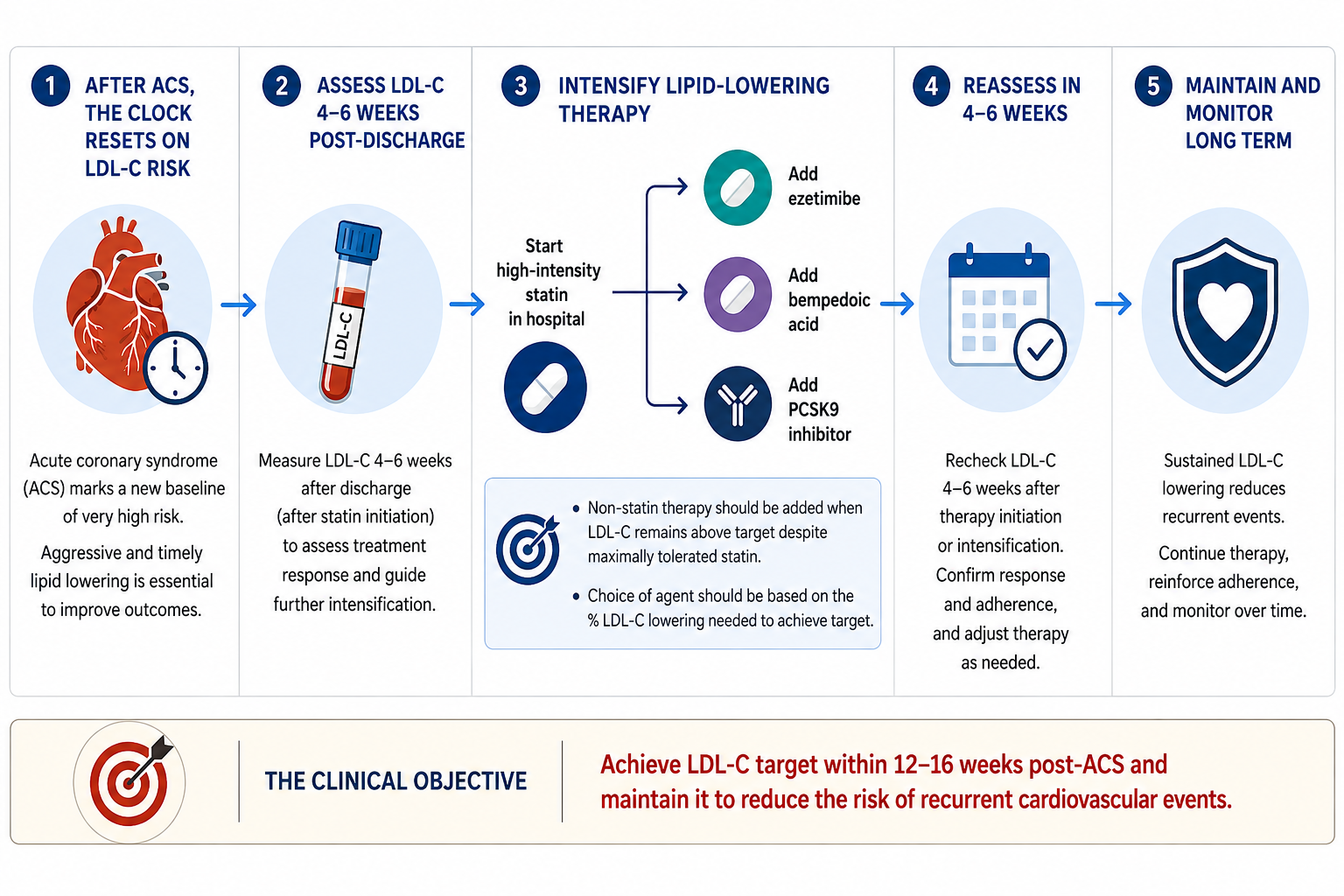
As early as 4 weeks post ACS. Most of the LDL lowering with a statin occurs at about 4 weeks post initiation or dose change and reaches a stable value at 8 weeks and beyond. You can combine this with a check of K and Creatinine especially if on a RAAS inhibitor (ACE, ARB, ARNI, MRA) and I would also use this opportunity to check the Lipoprotein (a). ApoB may also be helpful especially if the triglycerides are elevated.
The CCS pathway recommends you check fasting lipids at 1 month then again as a non-fasting panel every 2-3 months to reassess if you have made any dose changes or additions to the lipid lowering therapy. Some primary care teams/groups and specialist physician groups have standardized pathways in their clinics to ensure this happens. In some hospitals, they have introduced protocols to give the 1-month requisition at time of discharge.
I measured the lipids at 4 weeks post ACS. What do I do now?
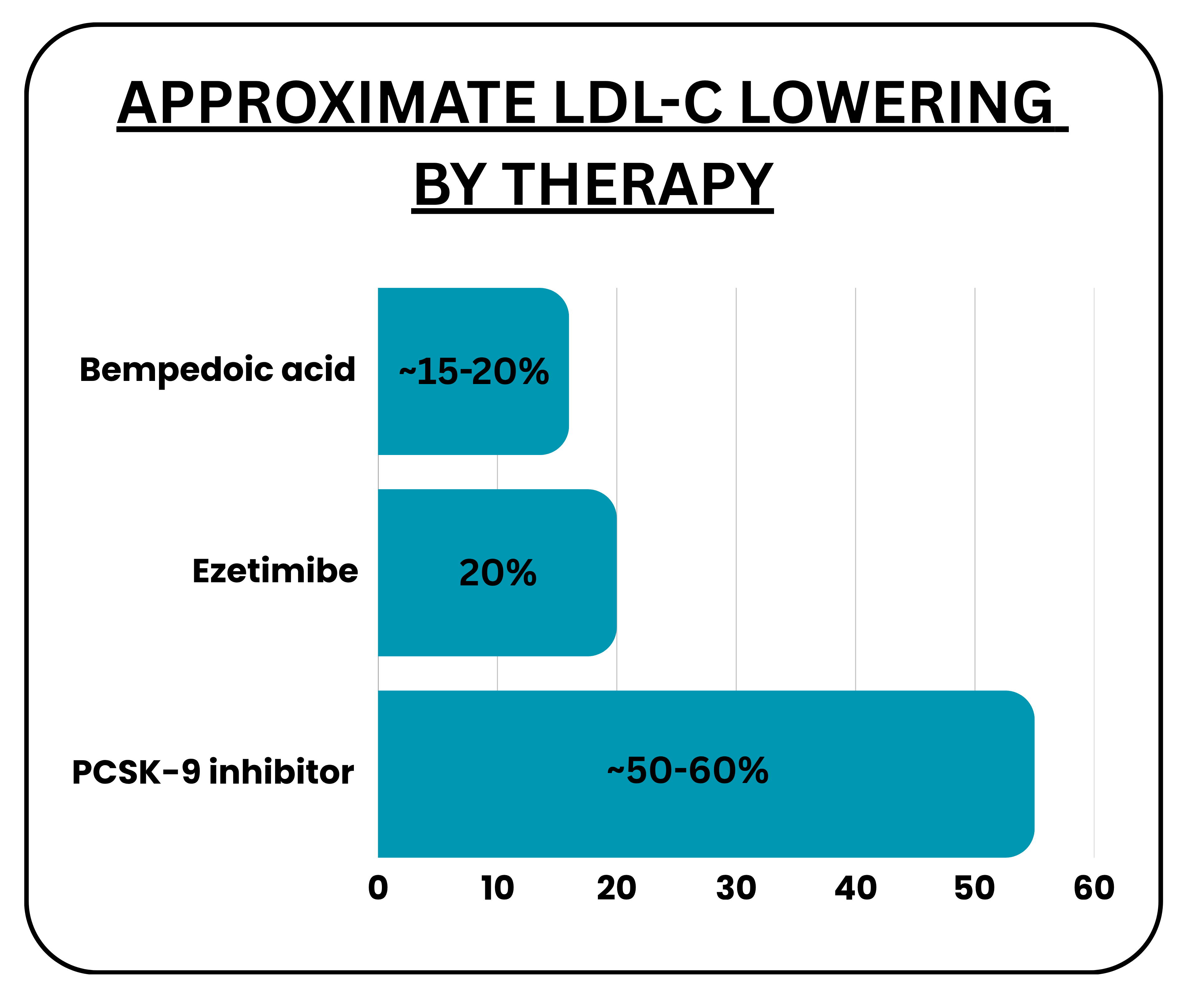
If you are below threshold (1.8, 1.4 or 1 mmol/L – your choice) then congratulate your patient and reinforce the importance of taking the medication lifelong to minimize CV risk. If you are above threshold then it depends… what level are you at and what do you need to get there? By way of background, it is helpful to understand your tools – Ezetimibe lowers LDL by about 20% and the injectables (PCSK-9 inhibitors) lower the LDL by about 50-60%. Bempedoic acid is new to Canada but used for years elsewhere and was Health Canada approved in Nov 2025 so it did not make the CCS pathway document – it lowers LDL by about 15-20% and is referenced in both the ESC and the ACC/AHA guidelines.
So if you are ‘close’ to 1.8 mmol/L (1.8 to 2.2) then start with Ezetimibe. Add on a PCSK-9 inhibitor if still above threshold or if you are using the lower ESC or ACC/AHA recommended targets.
If you are ‘not close’ to 1.8 mmol/L (in other words > 2.2 mmol/L) then adding on Ezetimibe alone is unlikely to achieve threshold – so start a PCSK-9 inhibitor.
In addition, if triglycerides are 1.5-5.6 mmol/L, consider icosapent ethyl 2g bid to also lower risk.
Easy to say, not so easy to do - how do I start these medications, who pays and is there now expanded access?
It varies – with both public provincial and private reimbursement. This is a national blog but I will limit the discussion to public reimbursement in Ontario for space considerations.
For Ezetimibe – tablet – single dose 10 mg once daily, LU code 380 for threshold and code 381 for statin intolerance.
For Bempedoic acid – tablet – single dose 180 mg once daily, no public coverage yet in Ontario.
For Icosapent ethyl – 1g caps – 2 caps twice daily – apply to Exceptional Access Program either through Patient support program or direct to MOH - SADIE website is also an option.
For inhibitors of PCSK-9:
Inclisiran – single SQ injection at initiation then at 3 months – followed by injection q6 months ongoing. LU code 732 for familial hypercholesterolemia (FH) only. Note that the 2 secondary prevention outcome trials for Inclisiran have yet to complete but are close.
Alirocumab – usual dose is single SQ injection 150 mg q2weekly – LU code 555 for FH only.
Evolocumab - single injection 140 mg q2weekly – LU code 527 for FH. However also *unique* LU code 737 for post recent ACS (within 52 weeks of event) which helps inform the relative urgency of post ACS lipid assessments! This applies not only to ODB patients but coverage is often granted through the Trillium Drug Program which provides support for Ontarians whose drug costs are excessive in relation to household income.
Note that the post-ACS patient was well studied with the two latter agents - Alirocumab through the Odyssey-Outcomes trial (all patients enrolled were within 12 months post ACS) and Evolocumab through the Fourier trial (included 5711 patients within 12 months post ACS, or 21% of the total number of subjects).
Sounds good – but how do I change my practice?
Where there is a will there is a way. But planning takes effort and change should be both with the individual (*you*) and within your micro medical eco-system. Practices vary so solutions vary - but there are common threads. Firstly recognize and flag the post-ACS patient. Either do so on receipt of the discharge summary or if you are following up yourself after providing inpatient care, then do so through your EMR or office assistant.

Secondly, check the lipids. It is easy to let these things slide without updated lab values so we have to ensure that a requisition is provided to the patient in advance of the appointment. Some hospital protocols provide a requisition as a part of the discharge checklist. Others have flagged their EMRs and devised ‘preset’ post ACS lab reqs that incorporate necessary testing (lipid profile but also Lp(a) and K/Cr/apoB as indicated). Directives are put in place for admin staff or allied health team members to send reqs in advance with instructions to draw before visit.
Thirdly, address the lipids. If you know the thresholds, understand the medications and their expected LDL reduction, it is very hard to ignore if you have updated lipid values in front of you. As most patients go home on top dose statins, the conversation is not about uptitration and is more about the next add-on medication. And with lower thresholds and expanded access to drugs like Evolocumab, we are in a better place to further lower risk for our patients.
Lastly, follow-up after intervention. The CCS pathway suggests follow-up at least every 3 months for the first year (could be primary care or specialist). This frequency is also well suited to rechecking lipids, ensuring adherence, assessing for adverse effects, and ensuring that thresholds are met. Lipid checks also lend themselves well to virtual visits as such counselling requires less in-person data for decision making.
Enjoy this area of study? Check out our related OnDemand content:
 The New Lipid Wars: Targets, Treatments and Controversies
The LDL Reckoning: Why ACS Changes Everything
Graphical Abstract
References:
Bhatt P et al. Closing the practice gap in secondary prevention after acute coronary syndromes: A provincial implementation pathway. Can J Cardiol. 2025. doi: 10.1016/j.cjca.2025.10.016.
Blumenthal RS et al. 2026 ACC/AHA/AACVPR/ABC/ACPM/ADA/AGS/APhA/ASPC/NLA/PCNA Guideline on the Management of Dyslipidemia. Circulation. Published online March 13, 2026. doi: 10.1161/CIR.0000000000001423.
Canadian Cardiovascular Society. CCS Secondary Prevention Pathway. 2025. Available from: https://ccs.ca/guidelines/ccs-secondary-prevention-pathway/
Feingold KR. Cholesterol Lowering Drugs. [Updated 2026 Apr 23]. In: Feingold KR, Adler RA, Ahmed SF, et al., editors. Endotext [Internet]. South Dartmouth (MA): MDText.com, Inc.; 2000-. Available from: https://www.ncbi.nlm.nih.gov/books/NBK395573/
Gencer B et al. Efficacy of Evolocumab on Cardiovascular Outcomes in Patients With Recent Myocardial Infarction: A Prespecified Secondary Analysis From the FOURIER Trial. JAMA Cardiol. 2020;5(8):952-957.
Giugliano RP et al. Evolocumab and Clinical Outcomes in Patients with Cardiovascular Disease. N Engl J Med. 2017;376:1713-1722.
Mach F et al. 2019 ESC/EAS Guidelines for the Management of Dyslipidaemias: Lipid Modification to Reduce Cardiovascular Risk. Eur Heart J. 2020;41(1):111-188.
Pearson GJ et al. 2021 Canadian Cardiovascular Society Guidelines for the Management of Dyslipidemia for the Prevention of Cardiovascular Disease in Adults. Can J Cardiol. 2021;37(8):1129-1150.
Ray KK et al. Early and Late Benefits of High-Dose Atorvastatin in Patients With Acute Coronary Syndromes: Results From the PROVE IT-TIMI 22 Trial. J Am Coll Cardiol. 2005;46(8):1405-1410.
Schwartz GG et al. Alirocumab and Cardiovascular Outcomes After Acute Coronary Syndrome. N Engl J Med. 2018;379:2097-2107.
This blog was developed by the Collaborative CME and Research Network with a grant from Amgen.
Share Article
copyright © 2026 CCRN
Any views expressed above are the author's own and do not necessarily reflect the views of CCRN.